

Dentist for Children in Battle: For your child’s healthy smile .

Your child won’t keep his or her first teeth forever, but that doesn’t mean those tiny pearly whites don’t need conscientious care. Maintaining your child’s dental health now will provide health benefits well into adulthood, as primary (baby) teeth serve some extremely important functions.
For one thing, primary teeth serve as guides for the eruption of permanent (adult) teeth, holding the space into which these new teeth will erupt. The crowns (tops) of the permanent teeth actually push against the roots of the baby teeth, causing them to resorb, or melt away. In this way, the adult teeth can take their proper place. As a dentist for children in Battle, we are for you.
What’s more, your child’s primary teeth will be there for most of childhood, helping your child to bite, chew and speak. For the first six or so years, he or she will be relying on primary teeth exclusively to perform these important functions. Until around age 12, your child will have a mix of primary and permanent teeth. You will want to make sure those teeth stay healthy and are lost naturally — when it’s time.
Your child’s 20 baby teeth will usually begin to appear between six and nine months, although in some cases, it may start as early as three months or as late as twelve months. The two lower front teeth tend to erupt first, followed by the two upper ones. The first molars come in next, followed by the canines (eyeteeth). Sometimes your baby can experience teething discomfort during this process. If so, let us know and we will advise you as to the best course of action.Your infant’s gums and newly erupting teeth should be gently wiped after each feeding with a water-soaked gauze pad or damp washcloth. Starting at age 2, when there are more teeth in the mouth, establish a daily brushing routine with a small, soft-bristled toothbrush and no more than a thin smear of fluoridated toothpaste. Your child may need your help with this important task until about the age of 6.
The British Society of Pediatric Dentistry recommends that you bring your child in to see us by his/her first birthday. As your trusted dentist for children in Battle, we can teach you proper pediatric oral hygiene techniques, check for cavities, and watch for developmental problems.
There are a number of forms of tooth decay that can affect babies and small children. Early Childhood Caries (tooth decay) can develop rapidly, progressing from the hard, outer enamel layer of a tooth into the softer, inner dentin in six months or less.
Pediatric Dental Treatments
There are a variety of dental treatments we provide to prevent tooth decay in children, or to save or repair teeth when necessary. They include:
Topical Fluoride — Fluoride incorporates into the enamel of teeth, making it harder and more resistant to decay. Although there is a small amount of fluoride in toothpastes and in some drinking water supplies, we can apply a higher concentration onto your child’s teeth for maximum protection.
Dental Sealants — We can apply a plastic coating that prevents cavities by sealing the little grooves on the chewing surfaces of back teeth known as “pits and fissures.” These little crevices become the perfect environments for decay-causing bacteria. Immature tooth enamel is more permeable and therefore less resistant to tooth decay. Dental sealants are easy to apply and provide years of protection.
Root Canal Treatment — Perhaps you have had a root canal treatment yourself, to save an injured or severely decayed tooth. Well, sometimes children need root canals, too. As mentioned above, baby teeth are important guides to the permanent teeth that are already forming beneath your child’s gums. Therefore, saving them from premature loss can help prevent a malocclusion (“mal” – bad; “occlusion” – bite) that requires orthodontic treatment.
Bonding — Chips and minor fractures to front teeth — common childhood occurrences — can be repaired with tooth-colored bonding materials. These lifelike resins made of plastic and glass can be used on baby teeth as well as permanent teeth and last until the youngster has completed facial growth.
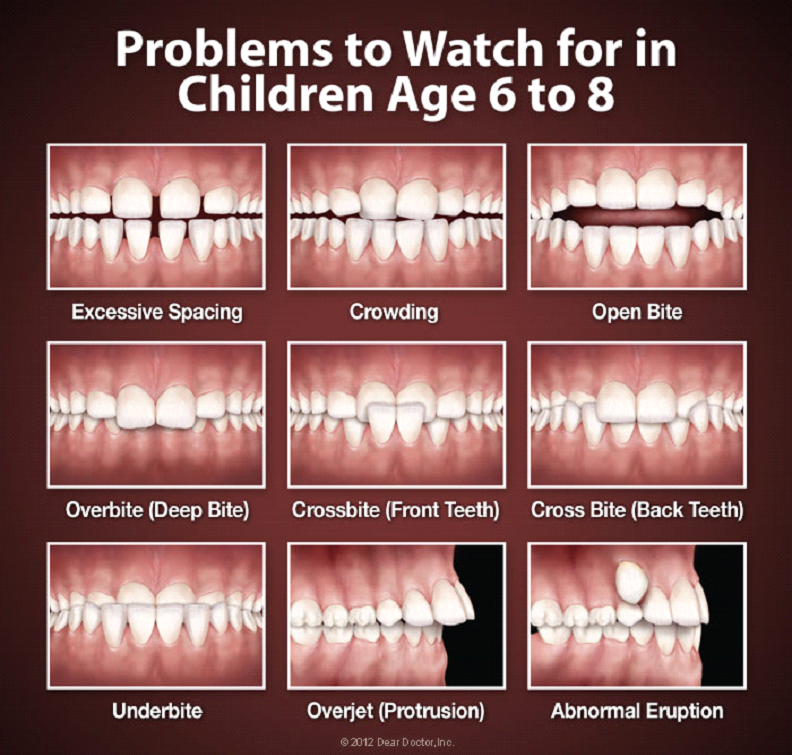
Orthodontic Concerns
By around age 8-10, most malocclusions have become evident. Interceptive orthodontic treatment around this time can help direct proper tooth positioning and/or jaw growth, eliminating or simplifying the need for later treatment. There are many orthodontic problems that can be detected early and are examples of why a trained professional, such as a dentist for children in Battle, should evaluate your child during his/her growth and development.
Sports & Your Child’s Teeth
If your child is active in sports, we highly recommend a custom-made mouthguard. According to the American Dental Association, an athlete is 60 times more likely to suffer dental harm when not wearing one of these protective devices. We can have a mouthguard custom-made specifically for your child using a model of his or her teeth that will offer greater protection than an off-the-shelf model. It’s an investment that pays off highly in the form of reduced pain, suffering — and dental expenses down the road! Please ask us about mouthguards at your child’s next appointment.
Options for dealing with tooth decay
Not all tooth decay is created equal. Although some decay may require invasive drilling, in its early stages it may be addressed through less invasive means. A dedicated dentist for children in Battle has a variety of minimally invasive interventions that can be used to tackle decay early. To help you partner with our practice in this fight against decay, here is a rundown of what tooth decay is and how it can be addressed in its infancy.
⦁ Early-Stage Decay
Teeth are covered with a thin film called plaque that contains bacteria. When you eat foods or drink beverages that have sugar in them, the bacteria produces acid. This acid causes tooth decay.
Tooth decay starts by softening the hard outer layer of your tooth called enamel. If it is not treated, it could become a cavity.
When tooth decay first begins, it can look brown or white. These are areas where the hard surface of your tooth, the enamel, is softening. At this point, we may have some choices about how to manage this decay—to make sure it doesn’t get worse.
⦁ Topical fluoride treatments
Fluoride is a mineral found in nature that makes enamel stronger. You may already know that drinking fluoridated water helps prevent tooth decay. But there are also products that can be put right on teeth to help strengthen tooth enamel. Research shows that these products can help stop or even reverse early tooth decay.
⦁ Fluoride varnish
Fluoride varnish is a gel that is painted onto the teeth. It hardens quickly into a thin sticky layer, allowing the fluoride to be absorbed by the enamel. Fluoride varnish is quick and easy to apply. It can be a good option for patients who have difficulty sitting through treatments. On the downside, it can make your teeth look a little yellow. Although this yellowish color only lasts for a few hours, the protection offered by fluoride varnish lasts months. You will need to have it reapplied in about 3 to 6 months, depending on the schedule you and our office works out.
⦁ Prescription-level fluoride toothpaste
Everyone over the age of two should use toothpaste that contains fluoride. You can buy over-the-counter fluoride toothpaste in the store without a prescription, but some patients need toothpaste that is higher in fluoride, which requires a prescription. For instance, our expert dentist for children in Battle recommends higher fluoride toothpaste for patients who have developed decay or early signs of decay. Also, patients who are at higher risk for decay, such as those under orthodontic treatment, may also benefit from prescription-level toothpaste.
⦁ Sealants
Sealants are a thin white coating applied to the chewing surfaces of your back teeth. These teeth have natural deep pits and grooves that trap plaque and food particles, increasing the risk of developing tooth decay. The sealant hardens and covers the pits and grooves, helping keep the plaque and food out and protecting your teeth. Sealants have been shown to stop some early tooth decay.
Sealants can be used alone or with a fluoride varnish. Sealants can last for years, but our office regularly examines sealed teeth to check that the sealant is still covering the surface well.
⦁ Cavities
Once a tooth has a cavity, it may not be possible to reverse the tooth decay. But it is possible to stop more damage to the tooth. In some cases, we may decide to remove the decay with a small drill (which will involve the loss of some enamel) and then fill that area of the tooth or cover it with a crown. Or we may be able to consider an option that does not involve drilling into the tooth.